UAE Real Estate — Conflict Dislocation: Buying the Moat at a Discount
Emaar Properties & Aldar Properties — Long Idea, High Conviction
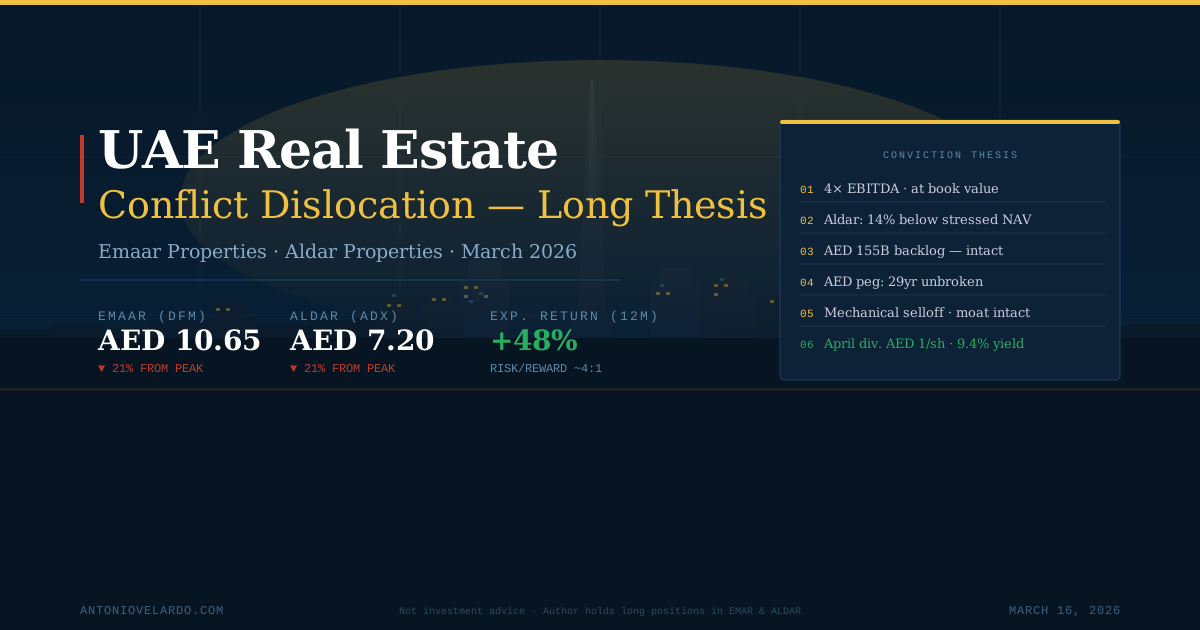
On February 28, 2026, coordinated US-Israeli strikes killed Iranian Supreme Leader Khamenei. Iran’s retaliation — 253 ballistic missiles, over 1,400 drones, direct hits on Dubai’s airport and several iconic structures — triggered the Dubai Financial Market’s first full closure since its founding. When trading resumed, eleven sessions of selling produced a uniform outcome: Emaar Properties and Aldar Properties both fell approximately 21%.
At the time of writing, both trade below levels that my own analysis — and every buy-side valuation framework I can construct — identifies as the fundamental floor assuming zero new property sales ever again.
At MoatInvesting, the question we ask before deploying capital is never “is the situation scary?” It is always “does fear change the competitive position of this business?” In this case, the answer is emphatically no. Dubai Mall’s position as the world’s most visited retail destination is not altered by a geopolitical conflict. Aldar’s contract to build Abu Dhabi’s social infrastructure does not disappear because Iranian drones struck Burj Al Arab. The moats are intact. The prices are not.
Investment Thesis — Summary
Section I
The Anatomy of a Sentiment-Driven Selloff
To understand why these stocks have fallen too far, you must first understand who was selling. Emaar carries 52% foreign institutional ownership, with foreigners representing approximately 70% of the free float. When geopolitical risk materialises, global EM funds execute risk mandates — not fundamental analysis. The selling is mechanical, not fundamental.
The evidence is the uniformity of the decline. Every company in every sector fell by approximately the same amount — real estate developers alongside toll operators alongside banks alongside telecoms. Businesses with zero dependence on tourism fell by the same percentage as those with significant exposure. This is the signature of risk-off capital flows, not genuine fundamental reassessment.
The current NAV discount (65%) sits between the long-run average (57%) and the COVID-era extreme (75%) — despite the underlying business being materially stronger today. In 2020, Emaar had a backlog of AED 43B and no committed dividend. Today the backlog is AED 155B (+260%), the dividend is AED 1/share yielding 9.4%, and S&P rates the company BBB+ stable. Fear has exceeded the facts.
“The market is repricing Dubai’s safe-haven narrative. It is not repricing Dubai Mall’s ability to charge AED 2,500 per square foot in annual rent to 1,200 tenants under contractual leases.”
Section II
Sum-of-Parts — The Correct Analytical Framework
The most frequent mistake when evaluating diversified real estate companies is applying a single blended multiple to blended EBITDA. Emaar contains two businesses that share a balance sheet but have fundamentally different earnings characteristics.
The Recurring Business — A Toll on Dubai’s Prosperity
Emaar’s recurring portfolio — Dubai Mall and satellite retail, the Address and Vida hotel network, commercial leasing — generated AED 8.2B in EBITDA in FY2025. These are contractual income streams from tenants under multi-year agreements, not development profits dependent on new buyers.
Dubai Mall deserves separate treatment. It is not merely a large shopping centre. It is an infrastructure asset — the world’s most visited building, with 111 million visitors in 2024. A 2014 RICS-compliant independent appraisal filed with the DFM valued it at AED 34.4B on AED 1.99B in passing rent. Applying income capitalisation to today’s ~AED 3.5B net operating income at a crisis-adjusted 6.5% cap rate produces a standalone value of AED 53.8B.
| Asset / Component | FY25 EBITDA | Stress | Stressed EBITDA | Multiple | EV (AED Bn) |
|---|---|---|---|---|---|
| Dubai Mall & retail | 4.9B | −15% | 4.2B | 9.5× | 39.9B |
| Hotels & hospitality | 1.5B | −40% | 0.9B | 9.5× | 8.6B |
| Commercial leasing | 1.1B | −20% | 0.9B | 10× | 9.0B |
| Entertainment & other | 0.7B | −40% | 0.4B | 9× | 3.6B |
| Total recurring | 8.2B | −25% | 6.1B | 9.9× | 61.1B |
| Development (run-off DCF, 12.5% WACC) | — | conservative | — | — | 25.6B |
| Land bank (618M sqft at AED 30/sqft) | — | distressed | — | — | 18.5B |
| International + financial assets | — | at book | — | — | 4.3B |
| Free cash (non-escrow) | — | — | — | — | 18.5B |
| Less: gross debt | — | — | — | — | (9.2B) |
| Total equity value / per share (after 15% tax adj.) | AED 11.43 | ||||
Section III
Book Value — The Floor Most Investors Miscalculate
Emaar’s estimated year-end 2025 book value is approximately AED 94.2B — or AED 10.65 per share. At current price you are buying at almost exactly book value. But this number requires significant adjustment to be analytically useful.
| Adjustment | Direction | Per Share (AED) | Rationale |
|---|---|---|---|
| Reported book value (est. Dec 2025) | base | 10.65 | Audited equity + FY2025 profit − declared dividend |
| Less: goodwill & intangibles | − | (0.35) | Fully excluded; no franchise value credited |
| Less: WIP haircut (15% on AED 41.3B) | − | (0.70) | Crisis liquidation mark on construction in progress |
| Add: land revaluation surplus | + | +1.45 | UAE land carried at cost; conservative 30% uplift |
| Add: investment property uplift | + | +2.08 | Dubai Mall at depreciated cost; JLL implies AED 53.8B vs ~AED 35B book |
| Less: 15% tax on unrealised gains | − | (0.53) | Prudent deferred tax charge |
| Less: escrow reclassification | − | (0.95) | Portion ringfenced for construction; not freely available |
| Conservatively adjusted book value | 11.65 | 9% premium to current price | |
Even after applying a 15% haircut to all development WIP, excluding goodwill entirely, and charging a 15% deferred tax on unrealised property gains, the conservatively adjusted book value per share is AED 11.65 — 9.5% above current price. You are buying at a discount to even the most conservative measure of intrinsic asset value.
Section IV
Earnings Power Value — The No-Growth Floor
Earnings Power Value (EPV), developed by Columbia Business School professor Bruce Greenwald, asks: what is this business worth if it never grows again? It capitalises sustainable normalised earnings at WACC, producing the theoretical value floor.
| Input | Normal | Crisis-Stressed | Extreme Stress |
|---|---|---|---|
| Recurring EBITDA (FY2025) | 8.2B | 8.2B | 8.2B |
| Less: D&A on recurring assets | (1.6B) | (1.6B) | (1.6B) |
| Crisis haircut to EBIT | 0% | −25% | −40% |
| Normalised recurring EBIT | 6.6B | 4.95B | 3.96B |
| Less: UAE corporate tax (9%) | (0.59B) | (0.45B) | (0.36B) |
| Normalised NOPAT (recurring only) | 6.01B | 4.50B | 3.60B |
| WACC applied | 9% | 10.5% | 12% |
| EPV equity / per share | 76.1B / AED 8.61 | 52.2B / AED 5.91 | 39.3B / AED 4.45 |
Development business, land bank, and AED 155B backlog are entirely excluded above — zero-cost optionality at current price.
At AED 10.65, you are paying approximately AED 2–6/share above the EPV of the recurring business alone. That differential is the price you pay for the entire development machine, the land bank, and the backlog optionality. In a company with Emaar’s operational track record, that is not expensive optionality.
Section V
Aldar — The Sovereign Shield
If the Emaar thesis is about buying a world-class franchise at distress prices, the Aldar thesis is about buying the most defensively positioned real estate company in the Gulf at those same prices. Four structural advantages make it categorically different from Emaar in a prolonged conflict:
Resident buyer base: 74% of Aldar’s UAE property sales originate from residents — people already living in Abu Dhabi who need housing. Foreign investors pause first in a crisis. Resident buyers locked into payment plans for homes they intend to occupy are structurally more resilient.
Government client relationship: Aldar’s project management division manages AED 95B in social infrastructure works directly for the Abu Dhabi government — schools, hospitals, community facilities. This portfolio is pre-funded, working-capital-neutral, and generates over AED 1B in fee income annually regardless of private market conditions.
Education portfolio: Aldar Education serves 36,000 students across its K-12 platform. Parents do not withdraw children from school because of regional geopolitical events. Fee revenue in Q2 2026 will look almost identical to Q2 2025. This is arguably the most recession-proof income stream in any MENA real estate portfolio.
Mubadala sovereign backstop: Abu Dhabi’s sovereign wealth fund holds a 25% direct stake with over USD 300B in AUM. Its capacity to inject equity capital before any covenant breach is enormous — an implicit put option with very real economic value not captured in any multiple-based valuation.
| Component | FY25 EBITDA | Stress | FY26E EBITDA | Yield | EV (AED Bn) |
|---|---|---|---|---|---|
| Project management (govt.) | 1.0B | −10% | 0.9B | 7.0% | 12.2B |
| AIP retail & residential | 1.1B | −7–10% | 1.0B | 8.5–9.0% | 11.1B |
| AIP commercial & logistics | 0.9B | −7% | 0.8B | 8.5–8.8% | 9.3B |
| Hotels | 0.4B | −30% | 0.3B | 10.5% | 2.5B |
| Education (36k students) | 0.3B | −5% | 0.3B | 8.0% | 3.3B |
| UAE development (run-off) | — | conservative | — | — | 17.9B |
| Cash, investments less net debt | — | — | — | — | (7.5B) |
| Total equity (after 15% tax) / per share | AED 8.20 | ||||
The stressed sum-of-parts arrives at AED 8.20 — 14% above today’s price of AED 7.20 — after assuming no new off-plan launches, persistent stress across hospitality and retail, and cap rate expansion of 150 basis points from normal levels.
Section VI
How Bad Does It Have to Get to Lose Money?
For Emaar at AED 10.65, permanent capital loss requires all four of the following simultaneously:
1. Conflict extends beyond 24 months with no credible resolution path. A ceasefire at any point within the next few months would trigger an immediate re-rating eliminating the bear case entirely.
2. Dubai Mall occupancy falls below 70%. It was 98.5% in FY2025. During the full COVID pandemic — when international air travel globally collapsed — Dubai Mall maintained occupancy above 85%. A decline to 70% requires not merely reduced footfall but actual tenant defaults and lease surrenders.
3. The April 2026 dividend is cancelled. Management has committed to AED 1/share with an ex-date of April 3. The company holds AED 18.5B in free cash against AED 9.2B gross debt. Controlling shareholders themselves receive approximately AED 3B of the total AED 8.84B distribution. There is no financial necessity for cancellation.
4. AED peg comes under material stress. The dirham has been pegged at 3.67 since 1997, maintained through the Asian financial crisis, September 11, the 2008-2009 global financial crisis, the 2014-2016 oil price collapse, and COVID. UAE gross foreign reserves exceed USD 170B.
Sustained Iranian targeting of Abu Dhabi’s energy infrastructure — the Ruwais refinery complex or ADNOC offshore production platforms — would be categorically different from the Dubai strikes already observed. This threatens the UAE’s fiscal capacity and the economic foundation backstopping the peg and Mubadala’s support for Aldar. If this escalation materialises, existing positions should be maintained but new deployment should pause pending assessment.
Section VII
Scenario Analysis & Probability-Weighted Returns
Bull Case
+69–97%
Ceasefire within 6–8 weeks. Dubai’s safe-haven narrative rehabilitates within one quarter. April dividend paid, anchoring sentiment. Foreign buyers return to off-plan market by Q3 2026. Emaar re-rates toward pre-war multiple of 8.5× on FY2026 EBITDA. Both stocks reach prior highs within 9–12 months.
Base Case
+31–60%
Resolution takes 3–6 months. Confidence rebuilds gradually. Development launches resume at 40–50% of 2025 pace by year-end. Q1 recurring results confirm malls held up. Emaar reaches pre-war levels by month 9. Aldar recovers to AED 10–11 driven by resident buyer resilience and government construction programme.
Bear Case
−15 to −25%
Conflict extends 18–24 months. Foreign capital flight continues. Development EBITDA collapses 60–70%. Recurring income down 35%. Emaar drifts toward EPV floor. Aldar holds better at AED 6.50–7.00, protected by government clients. Long-term investors average aggressively — setting up extraordinary 3-year returns.
Probability-weighted expected return | Bull 35%×+83% + Base 45%×+46% + Bear 20%×−20% ≈ +48%
Asymmetric profile: ~4× as much upside in the bull case as downside in the bear case, before probability weighting.
Section VIII
Capital Deployment — Staged Position Building
Identifying a mispriced security is necessary but not sufficient. The second discipline is position sizing — committing a meaningful initial position while retaining capital for deployment at lower prices if sentiment continues to deteriorate.
The April 23 Dividend — A Timing Consideration: Emaar’s AED 1/share dividend carries an ex-date of April 3 and payment date of April 23, 2026. Under UAE Commercial Companies Law, once approved at the AGM (expected late March), the dividend becomes a legal debt of the company. At AED 10.65, this represents a 9.4% yield in a single payment arriving within weeks, reducing effective net cost basis to AED 9.65 on payment date.
Conclusion — When Moats Matter Most
Dubai Mall has one of the most durable moats in global real estate. It is geographically irreplaceable — there is one Downtown Dubai, one Burj Khalifa, one Dubai Fountain. The infrastructure surrounding it has been built over two decades and cannot be replicated. These are not assets that a conflict erases. They are assets that a conflict temporarily suppresses and that re-emerge, historically stronger, once the disruption passes.
Aldar’s government client moat — the sole trusted partner for Abu Dhabi’s social infrastructure programme — is equally durable. It is not built on any single building. It is built on a decade of trust and technical delivery in the eyes of the world’s most financially powerful city-state. That relationship does not fracture because of a geopolitical event in a neighbouring theatre.
At AED 10.65 for Emaar and AED 7.20 for Aldar, the weighing machine is on the long side. The voting machine has been heard. It is time to act accordingly.
Antonio Velardo holds a long position in Emaar Properties PJSC (DFM: EMAR), initiated at AED 11.05 per share. A position in Aldar Properties PJSC (ADX: ALDAR) is being initiated at or around current market prices. All prices as of market close, March 16, 2026. This research note represents the author’s independent analysis and does not constitute investment advice, an offer to buy or sell securities, or a solicitation of any kind. All valuations, projections, and scenario analyses are estimates and carry material uncertainty. Past performance is not indicative of future results. Investors should conduct their own due diligence and consult qualified advisers before making investment decisions. All monetary figures in UAE Dirhams (AED). USD/AED: 3.67 (fixed peg). © 2026 MoatInvesting. All rights reserved.