Antonio Velardo · Chief Investment Officer, MoatInvesting · April 2026
Author holds a long position in ETOR
The plan was to be in Ho Chi Minh City. I had been invited to present the eToro investment thesis in person at the second Asia event organised by FatAlpha — a conference bringing together serious investors from across the region. The slides were ready. The numbers were memorised. Then the war made it impossible to travel.
Sophocles, the host of the show, could have just left it there. Instead, he reached out and asked whether I would be willing to walk through the thesis live on the podcast — same slides, same analysis, just done remotely rather than from a stage in Vietnam. I said yes, and what came out of that conversation is the video you will find at the bottom of this article.
I am sharing it here because since that episode aired, $ETOR has moved higher. Not because of anything that changed in the business — the business has been doing exactly what I described. It is moving because more investors are starting to make the one arithmetic adjustment that changes everything about how this company reads on a screen. We are still early in that process.
The written analysis below covers the full thesis in considerably more depth than the conversation did. Read this first — the video is at the bottom.
Investment Thesis — Summary
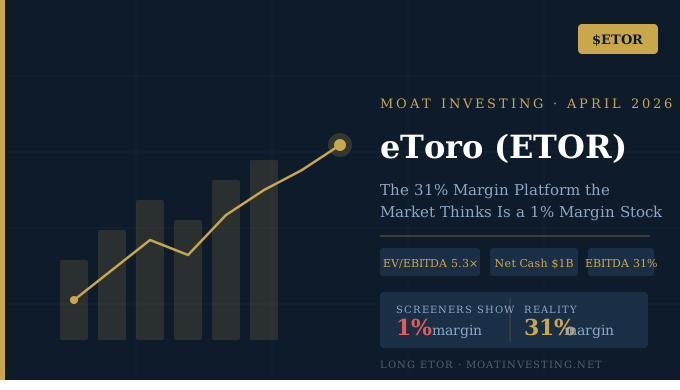
One accounting rule inflates eToro’s reported revenue 16× and compresses its apparent margins to 1–2%. Strip it out and you find a business with a 31% EBITDA margin and $216M in GAAP net income — invisible to every quant screener on the planet.
The valuation is extreme. At 5.3× trailing EBITDA against a peer median of 12.7×, you are buying the adjusted asset value — $32.87 per share — at below reproduction cost. The $1.02 billion net cash position alone represents 39% of the entire market cap.
Every growth option is free. US CopyTrading, Singapore, eToro Money at 5M accounts, Alpha Portfolios, AI product acceleration, the $125 trillion generational wealth transfer — every single one of these is priced at exactly zero in the current share price.
The downside is protected. Even if every crypto trade disappeared from the platform permanently, eToro still generates $99M in EBITDA and holds $1B in cash. The floor is not zero — and the floor is not far from today’s price.
Section I
What eToro Actually Is
eToro (Nasdaq: ETOR) was founded in Tel Aviv in 2007. It IPO’d in May 2025 at $52, opened its first trading day at $69.69, closed at $67, and has since been cut to the low $30s — not because the business deteriorated, but because accounting has made it look far worse than it is.
The platform has 40 million registered users across 140 countries and does six things simultaneously that no single competitor does together:
| Capability | What It Means | Why It Matters |
|---|---|---|
| Stock brokerage | Commission-free trading on 25 global exchanges, fractional shares from $1 | Core acquisition funnel for new investors worldwide |
| Crypto exchange | 100+ cryptocurrencies, staking, custody wallet | US volume tripled in one quarter when they expanded from 3 to 110 tokens |
| CopyTrader (patented) | Mirror any verified investor’s live portfolio with one click, no fees, no lock-up | 15-year-old patented network effect — the core moat, impossible to replicate overnight |
| Smart Portfolios | 127+ curated strategies co-developed with BlackRock, Franklin Templeton and Amundi | Recurring AUM fees; deepens institutional relationships |
| eToro Money | Visa debit card, 4% stock cashback, currency exchange, transfers | Debit card volume +650% YoY; transforms eToro from broker into financial super-app |
| AI platform (Tori) | AI companion for navigation, portfolio understanding and investor education | Every new feature built 100% by AI — 10× faster product velocity at lower cost |
The strategic vision is explicit: become the financial super-app for the next generation of investors — the people who want to invest through a social, mobile-first, AI-powered platform they control themselves, not through a bank or an advisor.
Section II
The Accounting Illusion That Created This Opportunity
Type ETOR into Bloomberg, Yahoo Finance, or any screener and it shows 1–2% operating margins. Every algorithmic strategy, every quality-factor ETF, every quant fund passes on it. The numbers look terrible.
The numbers are not terrible. They are being destroyed by a single accounting rule.
Under US GAAP (ASC 606), when a user buys $20,000 of Bitcoin on eToro, the accounting requires eToro to record the full $20,000 as revenue — not the spread, not the fee, the full transaction value. Then it records the $19,800 cost of acquiring that Bitcoin as cost of revenue. eToro’s actual economic gain from the transaction — the spread it kept — is $200.
| What GAAP Shows | GAAP Amount | What It Actually Means | Economic Reality |
|---|---|---|---|
| Revenue | $20,000 | Full Bitcoin transaction recorded as revenue | Inflated 100× |
| Cost of Revenue | ($19,800) | Cost of Bitcoin acquisition recorded as COGS | Pass-through, never eToro’s money |
| Gross Profit (apparent) | $200 | 1% apparent margin | The only real number in this row |
| Net Contribution (real) | $200 | What eToro actually earned on the trade | 31% EBITDA margin |
eToro invented a metric called Net Contribution specifically to fix this. They strip out the gross crypto flows and show only what the company actually kept. The result in FY2025:
Most of the market has not made this adjustment. Most screeners, most algorithms, most passive strategies that filter by quality metrics — they see 1% margins and move on. That is the opportunity.
Section III
Adjusted Asset Value — What You Are Actually Buying
The adjusted asset value (AAV) framework asks: what would it cost to reproduce this business from scratch? It is the balance sheet rebuilt with economic reality rather than historical cost accounting, capturing intangible assets that GAAP does not allow on the balance sheet.
| Asset / Liability | Reported ($K) | Adjustment ($K) | Adjusted ($K) |
|---|---|---|---|
| CURRENT ASSETS | |||
| Cash and cash equivalents | 1,072,641 | — | 1,072,641 |
| Restricted cash | 329 | — | 329 |
| Short-term investments | 202,688 | — | 202,688 |
| Counterparties | 249,055 | — | 249,055 |
| Cryptoassets | 62,606 | — | 62,606 |
| Receivable from omnibus accounts | 26,820 | — | 26,820 |
| Other receivables and prepaid expenses | 61,299 | — | 61,299 |
| Total Current Assets | 1,675,438 | — | 1,675,438 |
| NON-CURRENT ASSETS — REPORTED | |||
| Restricted cash | 11,688 | — | 11,688 |
| Right of use assets | 41,873 | — | 41,873 |
| Property and equipment, net | 7,361 | — | 7,361 |
| Goodwill and other intangible assets, net | 43,211 | — | 43,211 |
| Deferred taxes | 11,776 | — | 11,776 |
| NON-CURRENT ASSETS — OFF-BALANCE SHEET (ECONOMIC INTANGIBLES) | |||
| Regulatory licenses (75 jurisdictions) | — | +450,000 | 450,000 |
| Technology platform | — | +360,000 | 360,000 |
| Brand and user trust (40M registered users) | — | +247,500 | 247,500 |
| CopyTrader network effect (15yr patent, 3.8M funded) | — | +675,000 | 675,000 |
| Total Non-Current Assets | 115,909 | +1,732,500 | 1,848,409 |
| TOTAL ASSETS | 1,791,347 | +1,732,500 | 3,523,847 |
| Total Liabilities | 396,757 | — | 396,757 |
| Total Equity | 1,394,590 | +1,732,500 | 3,127,090 |
| Number of shares | 95,130 | — | 95,130 |
| Asset Value Per Share | $14.66 | — | $32.87 |
Section IV
Discounted Cash Flow — The Full Valuation Picture
| DCF Assumption | 2024 | 2025 | Rationale |
|---|---|---|---|
| EBITDA | — | $266,184K | EBIT-based, used for stress test |
| Tax Rate | 22% | 22% | Normalised (actual FY2025: 14.88%) |
| Reinvestment (R&D) | $131,071K | $151,247K | Growth capex, product and tech |
| NOPAT | $207,624K | — | Net operating profit after tax |
| Reinvestment Rate | 35% | 37% | High investment for future growth |
| ROIC | 15% | 15% | vs WACC 11.8% = value-creating spread |
| Growth Rate | 5% | 6% | Conservative; below consensus |
| WACC | 11.8% | 11.8% | Customer-weighted blended ERP |
| Valuation Output | Amount ($K) | Notes |
|---|---|---|
| Enterprise Value (EV) | 3,792,972 | DCF at 6% growth, 11.8% WACC |
| Net Cash (added back) | +1,018,178 | $1.02B net cash, zero debt |
| Equity Value | 4,811,150 | EV + net cash |
| Number of Shares | 95,130 | Diluted share count |
| Equity Value Per Share | $50.57 | +58% upside from ~$32 |
The consensus DCF (using a 2% terminal growth rate) arrives at $62.30 per share — 101% above current price. Even under a zero-growth stress test, the EPV floor is $28.80–$39.31 depending on whether growth capex is included — both scenarios supported overwhelmingly by the cash on the balance sheet.
Section V
Business Quality — What the Numbers Confirm
Nine consecutive quarters of funded account growth. That is the first number I look at in any consumer platform — and it is the number that tells you whether the moat is compounding or eroding. At eToro, it is compounding.
| Metric | FY2025 | YoY | Context |
|---|---|---|---|
| Net Contribution (real revenue) | $868M | +10% | The only revenue number that matters economically |
| GAAP Net Income | $216M | +12% | Audited, real — not adjusted |
| Free Cash Flow | $313M | ↑ | $3.29 FCF per share at current count |
| Net Interest Income | $175M | +18% Q4 | Grew in Q4 despite rate cuts — quality of deposit base |
| Interest-earning assets | $8.7B | +55% | Customer cash at Barclays and HSBC, earning market rates |
| Funded Accounts | 3.81M | +9% | 9 consecutive quarters of growth — the moat metric |
| Assets Under Administration | $18.5B | +11% | Each new dollar of AUA is recurring NII |
| ROIC (book capital) | 57% | — | vs WACC 11.8% — +45pp economic spread |
| ROIC (adjusted assets) | 13.5% | — | vs WACC 11.8% — still value-creating even on full reproduction cost |
| Crypto % of Net Contribution | 19% | — | Not 44% or 91% as often stated — far more diversified than perceived |
| Net Cash (zero debt) | $1.02B | — | 39% of current market cap. Balance sheet is a fortress. |
Section VI
Peer Comparison — How Mispriced Is This?
| Company | EV/EBITDA | P/E | EBITDA Margin | Notes |
|---|---|---|---|---|
| Robinhood (HOOD) | 18–22× | 35× | ~25% | US-only, no CopyTrading, higher valuation |
| Interactive Brokers (IBKR) | 14–16× | 22× | ~60% | Institutional focus, mature business |
| Coinbase (COIN) | 20–30× | 40×+ | ~30–40% | Crypto-only, higher beta |
| Peer Median | 12.7× | ~28× | ~35% | Market’s view of comparable fintech quality |
| eToro (ETOR) | 5.3× | 12× | 31% | Same quality, 58% discount to peers. One accounting rule. |
The discount is not explained by lower quality. EBITDA margins are comparable. ROIC is superior. Free cash flow is real and growing. The discount exists entirely because screeners show 1–2% margins on GAAP revenue that is 16× inflated. That is the trade.
Section VII
The Catalysts the Market Is Pricing at Zero
At current price, you pay fair value for today’s earnings and receive the following for nothing:
| Catalyst | Status | Potential Impact |
|---|---|---|
| US CopyTrading rollout | Live Oct 29, 2025 — phased rollout | The US is the world’s largest retail market. US retail equity participation is approximately 60% of adults (Federal Reserve/Gallup data) vs. single digits across most of Europe — eToro’s existing stronghold. The US is where the untapped scale is, and CopyTrading has barely started there. |
| Singapore MAS licence | Live | Opens high-wealth Asian investor base for the first time. Singapore is the gateway to the region’s private wealth market. |
| 24/5 trading | Live — S&P 500 + Nasdaq 100 | Expands the temporal boundary of the platform globally; differentiates from traditional brokers. |
| Accelerated buyback | $100M deployed of $250M authorization | Management buying at 42% below IPO price. $150M remaining. Signal of conviction; mechanically reduces share count at current prices. |
| AI platform (Alpha Portfolios + App Store) | Alpha live; ~1,000 apps in development | 10× faster product development at lower engineering cost. None of this is in the current price. |
| $125 trillion wealth transfer | 20-year structural tailwind | Boomers transferring wealth to Millennials over two decades. eToro is the natural platform for that generation’s financial life. |
| Sell-side re-rating | Coverage deepening post-IPO | As analysts cover the company and make the Net Contribution adjustment, the accounting distortion gets corrected in consensus models. The catalyst is not a business event. It is a perception event. |
Section VIII
Risks — Owned, Not Hidden
| Risk | Severity | Mitigation |
|---|---|---|
| Retail flow cyclicality | Medium-High | Retail trading volumes fall sharply in crypto and equity downturns. The 2018 crypto bear market showed how exposed the business can be to sentiment-driven volume swings. The diversification today — NII ($175M), eToro Money, Smart Portfolios — substantially reduces this risk relative to that period. But cyclicality is not eliminated. |
| Regulatory | Medium | Regulated in 75 jurisdictions simultaneously. Any adverse move on CFDs, CopyTrader reclassification, or crypto custody requirements could impact a revenue stream. The regulatory licence portfolio is a moat and a liability simultaneously. |
| Competition | Medium | Robinhood expanding in Europe; Coinbase dominant in US crypto; Interactive Brokers owns institutional retail globally. CopyTrader is the moat. Outside CopyTrader, the competition is serious and well-resourced. |
| Israel / Geopolitical | Low-Medium | Primary R&D in Tel Aviv. 18+ months of conflict have had no material impact per eToro’s SEC filings. “Not materially impacted so far” is not “no risk” — but the track record through a genuinely difficult environment is remarkably clean. |
Section IX
Scenario Analysis & Probability-Weighted Return
Sell-side coverage deepens, Net Contribution adjustment becomes standard. Re-rating to 10× EBITDA (still below peer median). US CopyTrading inflects meaningfully in H2 2026. Buyback accelerates. Stock reaches $55–65 within 12 months.
Multiple re-rates gradually to 7–8× as institutional coverage improves. Cash accumulation drives NAV per share to ~$16.83 by 2028. Even at 5× multiple — absurd for this quality — cash alone generates 55% return from today.
Severe market downturn crushes retail volume. NII compresses as rates fall further. Stock drifts toward EPV floor of ~$28.80. Cash balance prevents collapse. Long-term investors average down into an extraordinary 3-year set-up.
Section X
Position Building — How to Think About Entry
Conclusion — Long ETOR
The business is moving faster than the narrative.
One — the accounting adjustment changes everything. GAAP shows 1% margins. The real margin is 31%. The adjustment is one line of arithmetic. Most of the market has not made it. When they do — and they will, as sell-side coverage deepens post-IPO — the re-rating happens. The catalyst is not a business event. It is a perception event.
Two — the fundamental quality is real. Nine consecutive quarters of funded account growth. $868M in real economic revenue. $216M in GAAP net income. $313M in free cash flow. 57% ROIC on book capital. A business generating $300M+ of cash per year with no debt.
Three — the structure supports a re-rating. 5.3× forward EBITDA. $1.02 billion in net cash — 39% of the market cap — growing to approximately $1.6 billion by 2028. $250M buyback running at 42% below the IPO price. Even if the multiple stays at 5× — absurd for a business of this quality — cash accumulation alone generates a 55% return from today.
Four — every growth option is free. US CopyTrading. Singapore. eToro Money at 5 million accounts. Alpha Portfolios and the data flywheel. AI-driven product acceleration. The $125 trillion wealth transfer tailwind. Every single one priced at zero.
Long ETOR. The downside is protected by cash. The upside is protected by the moat. The opportunity exists because one accounting rule has made a 31% margin platform invisible to the tools most investors use.
Antonio Velardo holds a long position in eToro Group Ltd (Nasdaq: ETOR). All prices as of April 2026. This research note represents the author’s independent analysis and does not constitute investment advice, an offer to buy or sell securities, or a solicitation of any kind. All valuations, projections, and scenario analyses are estimates and carry material uncertainty. Past performance is not indicative of future results. All monetary figures in US Dollars unless otherwise stated. Investors should conduct their own due diligence and consult qualified advisers before making investment decisions. © 2026 MoatInvesting. All rights reserved.