Samyung Trading (KRX: 002810) — how to buy EssilorLuxottica's Korean crown jewel at eight times earnings, just as Korea forces its holdcos to pay up.
Moat Investing — August 2026. The author holds a long position in the security discussed and is adding to it. This is not investment advice; do your own research. All figures are sourced from DART regulatory filings and verified market data as of August 25, 2026.
The thesis in one paragraph
Samyung Trading is a sleepy Korean trading company with a market capitalization of 429 billion won, roughly 300 million dollars. Inside it sits a 49.8 percent stake in Essilor Korea, the dominant premium ophthalmic lens business in the country, a joint venture with EssilorLuxottica that earned 84.6 billion won of net income last year at a 25 percent net margin. Value that stake at just eight times earnings and it alone is worth about 359 billion won, or 84 percent of the entire market cap. Add roughly 340 billion won of consolidated net cash and financial investments, plus two more equity stakes, and you arrive at a sum of the parts somewhere between 34,000 and 53,000 won per share against a price of 23,250. The reason this gap exists is well known: Korean holding companies have traded at absurd discounts for decades because minority shareholders never saw the cash. That is precisely what is changing. Korea's Value-Up reform programme became law through 2025 and 2026, and Samyung has already responded: a formal three-year shareholder return policy, a dividend raised 69 percent, a Value-Up plan filed with the regulator in March, an activist on the register, and a controlling family that is buying more stock in the open market. The discount is old. The catalyst is new.
What Samyung actually is
On paper, Samyung Trading, founded in 1954, imports and distributes chemicals and industrial materials. That legacy business is real but modest, and it is not why anyone should own the shares. Samyung is best understood as an accidental holding company: a wrapper around one exceptional asset acquired long ago for almost nothing, surrounded by decades of accumulated cash that nobody ever asked management to return. The wrapper is boring. The contents are not.
The crown jewel: Essilor Korea
In the 1980s Samyung went into partnership with Essilor of France, today EssilorLuxottica, the global monopolist of premium ophthalmic lenses. The joint venture, Essilor Korea, distributes Varilux progressive lenses, Crizal coatings, Transitions and the rest of the premium range in one of the world's most eyewear-conscious markets. Samyung's audited filings show the stake was carried at an original cost of 796 million won. Today the same filings carry it at 168.6 billion won of book value, and even that number is an accounting fiction on the low side, because it simply accumulates Samyung's share of retained earnings rather than valuing the business.
The operating numbers, disclosed in Samyung's own DART filings because the stake is equity-accounted, are what a quality investor dreams about. Revenue of 332.6 billion won in fiscal 2025. Net income of 84.6 billion won, a 25.4 percent net margin, expanding to 27.1 percent in the first half of 2026. This is a business with monopoly-adjacent economics, a global brand behind it, and a demographic tailwind: Korea is ageing fast, and presbyopia is the most reliable customer acquisition channel ever invented.
The joint venture has also started doing something it rarely did in the past: paying its owners. Dividends received by Samyung from the JV went from 14.9 billion won in fiscal 2024 to 28.6 billion in fiscal 2025, and 29.9 billion won in the first half of 2026 alone. Cash is now flowing up the structure. That matters enormously for what comes next.
The rest of the balance sheet
Around the jewel sits a pile of money. Consolidated net cash and financial investments of roughly 340 billion won, or a more conservative 230 billion at parent-only level. There is a 25.3 percent stake in Chemilens Vietnam, a lens manufacturer that earned 19.8 billion won last year, and a 38.7 percent stake in Cubic Korea, which is separately listed on KOSDAQ and therefore marked by the market daily. None of these assets require heroic assumptions. Most of them are literally cash.
The sum of the parts
Here is the arithmetic, deliberately conservative. Take Samyung's 49.8 percent of Essilor Korea's 84.6 billion won of net income: that is roughly 42 billion won of look-through earnings. At eight times earnings, a multiple that would insult a business of this quality anywhere else in the world (EssilorLuxottica itself trades at well over twenty times), the stake is worth about 359 billion won. Add parent-level net cash and investments of 230 billion won, taken at face. Add the listed and unlisted minority stakes. You reach roughly 630 billion won of assets, before assigning any value at all to the legacy trading operations, against a market capitalization of 429 billion.
Our scenarios: a conservative case of 34,000 won per share, 46 percent above today's price, which values the JV at eight times and haircuts everything else. A base case of 43,200 won, 86 percent upside, at ten to eleven times the JV with cash near face value. A bull case of 53,200 won, 129 percent upside, if the JV commands a multiple that begins to resemble its parent's and the payout keeps ratcheting. An activist investor on the register, Value Partners, has publicly argued the whole company is worth one to two trillion won. We do not need them to be right. We need the discount to close partially.
| Asset | Basis | Value (KRW bn) |
|---|---|---|
| 49.8% of Essilor Korea | 8x FY25 look-through earnings (W42bn) | ~359 |
| Net cash & financial investments | Parent-level, at face (conservative) | ~230 |
| Chemilens Vietnam 25.3% + Cubic Korea 38.7% | Listed price / conservative estimate | ~40 |
| Legacy trading business | Assigned zero | 0 |
| Total assets (conservative) | ~630 | |
| Market capitalization (Aug 25, 2026) | W23,250 x 18.47M shares | 429 |
| Implied discount | ~32% |

Why the discount exists — and why that reason is dying
Nothing here is secret. The numbers are in public filings. The discount exists because for fifty years Korean controlling families treated listed subsidiaries as private property, cash never reached minorities, and the market rationally priced holdcos as roach motels: value goes in, nothing comes out. This is the famous Korea discount, and Samyung, illiquid, uncovered by any analyst, family-controlled, was a textbook case.
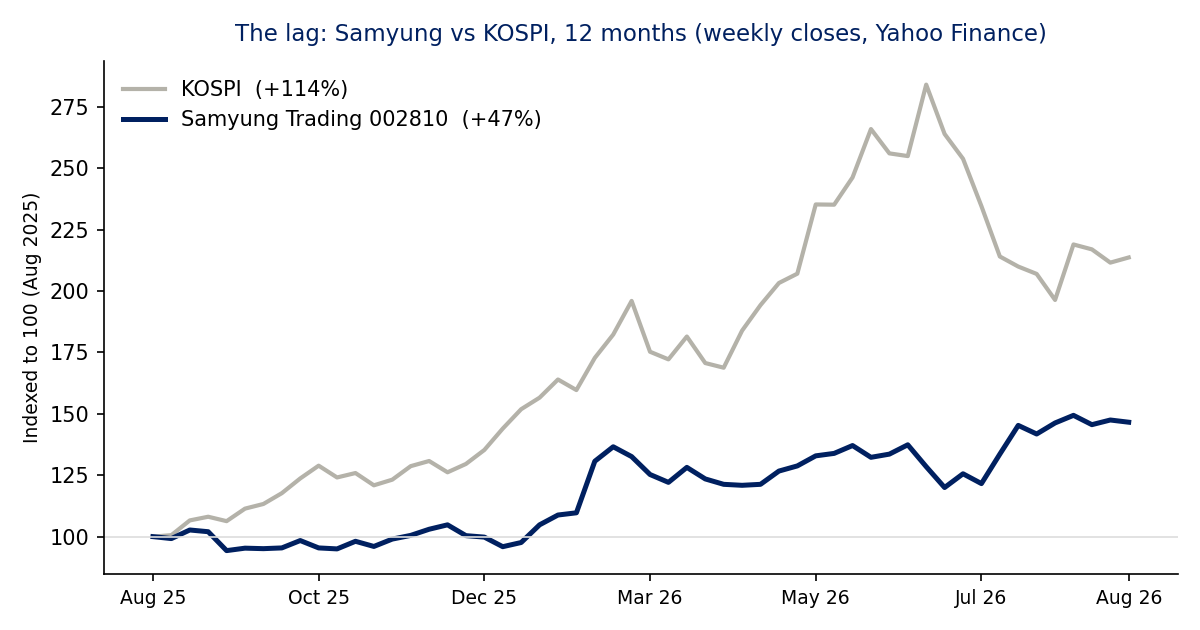
What is changing is the incentive structure of the entire market. Korea's Value-Up programme, launched in 2024 and hardened into law through 2025 and 2026, has moved from exhortation to compulsion: an amended commercial code, separate taxation of dividend income that rewards high-payout companies (passed in December 2025), and mandatory cancellation of treasury shares (effective March 2026) which kills the favourite tool of value entombment. The KOSPI has roughly doubled in twelve months as global investors re-rated the entire market. Samyung, notably, has lagged that index badly, up 23 percent since June against a market that has been far stronger for longer. The tide has come in; this boat is still on the sand.
The catalyst is not a promise — it has already started
This is the part of the thesis we like most, because it requires no faith. In February 2026 Samyung adopted a formal three-year shareholder return policy: a cash payout of at least 25 percent of consolidated net income, plus the annual distribution of 180,000 treasury shares in kind. The fiscal 2025 dividend was raised 69 percent to 1,181 won per share, a 35.8 percent payout and roughly a five percent yield at today's price. In March 2026 the company filed a formal Value-Up plan with the exchange. In January an activist went public and the stock rose 23 percent in a day. And through July, the controlling family increased its own stake from 45.68 to 46.74 percent, buying in the open market alongside minorities. Families do not buy more of what they intend to keep starving.
Note the mechanics of the dividend ratchet: the payout policy is written against consolidated net income, and consolidated net income includes the equity-method earnings of Essilor Korea, which are growing, and which are increasingly paid up in actual cash. The policy converts the hidden asset into visible income for every shareholder. That is the transmission belt between the jewel and your pocket.
Risks, honestly stated
First, the discount can persist. Korea discounts have broken hearts for decades, and a 46.7 percent family stake means minorities will never control the timetable. We are paid roughly five percent a year in dividends to wait, which makes patience cheaper, but the gap may close slowly. Second, the JV itself: Samyung owns 49.8 percent, not control, and EssilorLuxottica's side of the governance is not publicly documented; a change in the JV agreement, transfer pricing, or a buyout attempt at an unfair price are tail risks. Third, currency: returns are in won. Fourth, liquidity: this is a small, thinly traded stock, position sizes must respect that, and exits take time. Fifth, the legacy trading business consumes some capital and management attention and earns unremarkable returns; we assign it no value, but it can absorb cash. We size the position accordingly, at a level where a three-year wait would be an acceptable outcome, because the downside protection here is unusual: at today's price you are paying for the lens business at a single-digit multiple and receiving several hundred billion won of cash and securities almost free.
What we are doing
We are long and adding. The stock has moved 23 percent since early summer, and it remains, by our arithmetic, one of the cheapest claims on a world-class consumer franchise anywhere in Asia, attached to a catalyst that is legislative, already in motion, and aligned with the controlling family's own recent behaviour. The pitch is simple enough for a napkin: the optician is worth more than the company that owns it, the cash is real, and Korea has finally made it illegal to hide.
Disclosure: the author holds a long position in Samyung Trading (002810 KS) and may buy or sell at any time without notice. Sources: DART filings (Samyung Trading business reports and half-year report 2026), Korea Exchange disclosures, verified market data as of August 25, 2026. This article is for informational purposes only and is not investment advice or a solicitation. Figures involve estimates; the sum-of-the-parts values are the author's own computations.